


With March Madness concluding, talk about the 2026 draft class is hotter than ever. With a stacked, top heavy draft class, there has been much debate over who will be selected atop the draft come June. The draft lottery will give us a better idea on who is likely to be selected where, but for the time being, here are the current top 10 prospects on my big board.
#1: Darryn Peterson, SG/PG, Kansas

Stats: 20.2 PTS, 4.2 REB, 1.6 AST, 43.8 FG%, 38.2 3P%, 82.6 FT%
Despite Darryn Peterson’s Kansas being knocked out of the tournament by St. Johns in the second round of the tournament, he remains the standout prospect for me. Peterson has had a tumultuous freshmen year at Kansas, where his sometimes outstanding play was overshadowed by repetitive injury problems. Battling full body cramps, Peterson missed 11 games and requested to be substituted out of several second halves this year. Most other prospects would see a dramatic fall in their draft stock as a result of issues like these, but Peterson is one of the most talented scorers to come out of college basketball this century, keeping him in the running for the top pick. The Ohio native is a genuine 3 level scorer, who not only has impeccable touch, but explosive athleticism and a lights out jumpshot. Perhaps the most impressive aspect of his skillset is his ability to affect the game as both a primary shot creator, and a movement shooter. He displays a level of fluidity and polish in his game that is almost unheard of for a guard at his age. At 6’5, Peterson also has the frame, athleticism, and instincts to develop into a valuable NBA level defender. The injury concerns are real, but Peterson’s ceiling is too high to ignore, even in a draft class loaded with offensive talent.
#2: AJ Dybantsa, SF, BYU

Stats: 25.5 PTS, 6.8 REB, 3.7 AST, 51 FG%, 33.1 3P%, 77.4 FT%
AJ Dybantsa ended his season with a 35 point explosion against Texas, in what was his only game of the tournament. In his freshman season at BYU, Dybantsa has proven that he is an elite scorer with serious downhill driving ability. He was able to get to the rim with ease, while also shooting 52% on elbow jumpshots for the year, demonstrating outstanding midrange touch. Oftentimes this year however, he looked hesitant to shoot the three, shooting just 33% from deep on 4 attempts per game. The lack of elite talent around him at BYU limited his playmaking ability, but Dybantsa still displayed solid passing instincts and an ability to make the right reads in pick and roll situations. His combination of size and quickness will allow him to thrive as a switchable NBA defender. While it may take some time to adjust from his extremely high usage rate at BYU to filling a role on an NBA roster, Dybantsa projects as a future 25+ a night scorer at the NBA level who can defend from 1-4. His success in the league will hinge on his ability to generate offense for himself and others, alongside development in his off-ball movement.
#3: Cameron Boozer, PF, Duke
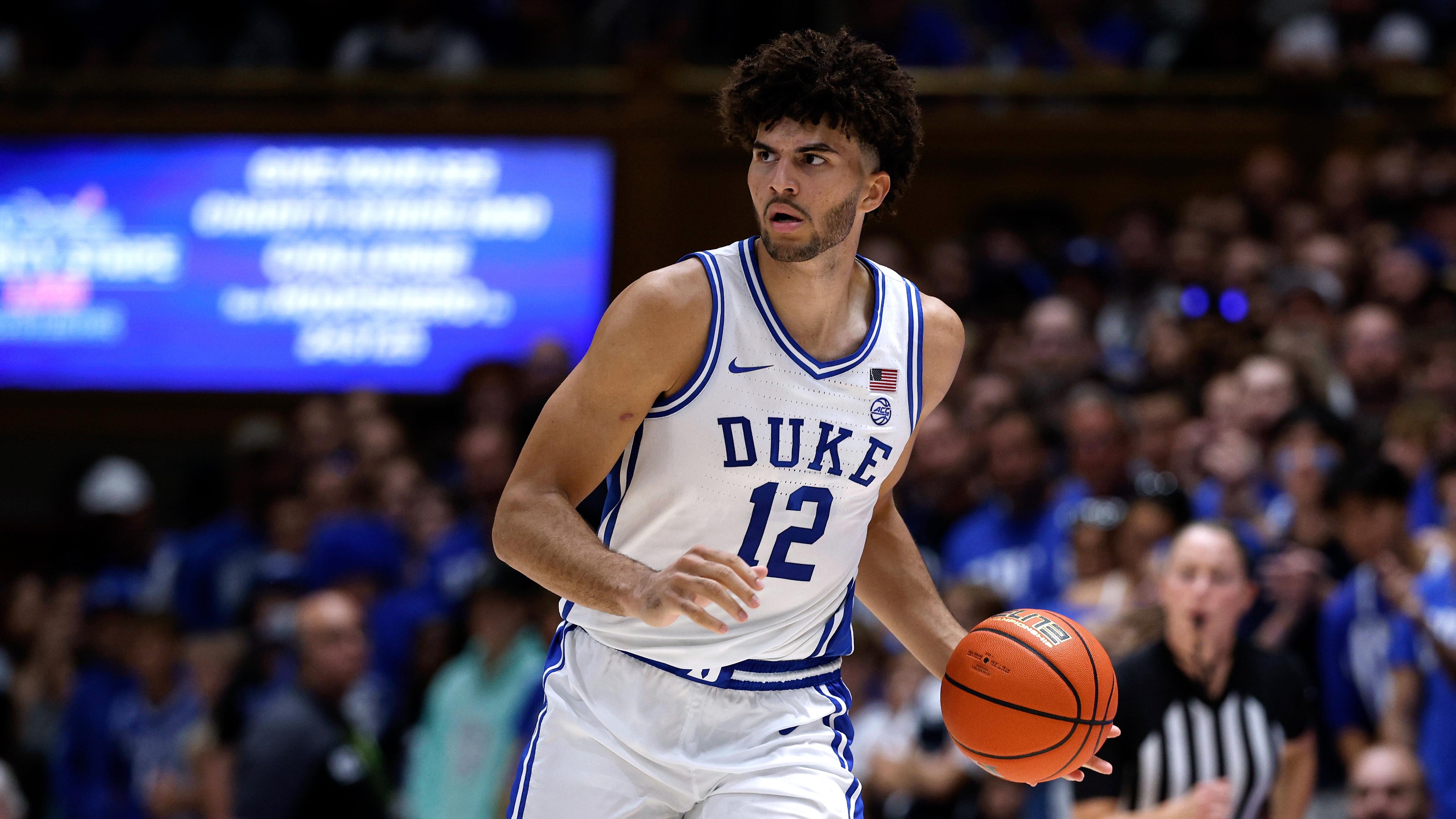
Stats: 22.5 PTS, 10.2 REB, 4.1 AST, 55.6 FG%, 39.1 3P%, 78.9 FT%
Cameron Boozer’s season ended in heartbreak after UConn hit a last second three to end Duke’s championship hopes. NBA scouts will no doubt be impressed with Boozer’s tournament play though, averaging 22.5 points and 10.5 rebounds in 4 games. Boozer is a strong and talented inside presence who has deft touch, while also making 39% of his threes this season, with smooth shooting mechanics. Offensively, his most impressive skill is his ability to pass the ball. This year, Boozer displayed playmaking ability out of the post, off handoffs, and outlet reads in transition. Defensively, Boozer will need to move his feet quicker to succeed as a switchable defender, which is a huge swing skill for power forwards in this generation. He sits in the “tweener” mold, where at 6 ‘9 he is likely too small to be a primary rim protector, while also not agile enough to guard on the perimeter. His lack of explosive athleticism is a real concern, particularly on the defensive end. Still, Boozer has a unique skillset for someone his size, and projects as a versatile do-it-all forward who will be able to impact winning in the league from the jump.
#4: Darius Acuff Jr, PG, Arkansas

Stats: 23.5 PTS, 3.1 REB, 6.4 AST, 48.4 FG%, 44 3P%, 80.9 FT%
At 4 is the SEC tournament MVP Darius Acuff Jr, who’s Arkansas were outclassed by Arizona in the Sweet 16. Acuff is the ideal modern point guard, a dynamic player comfortable both with and without the ball. He is an incredible shooter, making 49% of his catch and shoot threes, while also being able to shoot off the dribble. Acuff is also a terrific passer, particularly in the way he pushes the ball in transition, and limits turnovers by consistently making the right decisions. Also quite adept at getting to the free throw line; he shot 27 free throws in his final two games of the tournament. The concern with Acuff comes defensively, where he especially struggles with navigating screens and defending off the ball. At his size and stature, it is possible that Acuff is never able to become a productive NBA defender. NBA teams will be betting on his offensive upside translating into the league, similar to Tyrese Maxey of the 76ers.
#5: Caleb Wilson, PF, UNC

Stats: 19.8 PTS, 9.4 REB, 2.7 AST, 57.8 FG%, 25.9 3P%, 71.3 FT%
Caleb Wilson easily has the highest defensive ceiling of anyone in this class. Wilson is an incredible athlete at 6’10, who looks to dunk the ball with force whenever he has a lane. He is also a crafty scorer who is effective at backing down defenders to get into a fadeaway, or using his change of pace and explosiveness to finish through contact. Wilson shot 26% from three on just 27 total attempts for the year; he will need to improve his volume and efficiency at NBA level, but the team drafting him can be optimistic at developing this given his midrange touch. He also turns the ball over often when getting double teamed, but has shown some passing ability during his freshman year. His deep ball shooting and playmaking will be a swing skill, but Wilson will be able to impact winning in the NBA even without reaching his ceiling, as an elite defender and cutter.
#6: Labaron Philon Jr, PG, Alabama

Stats: 22 PTS, 3.5 REB, 5 AST, 50.1 FG%, 39.9 3P%, 79.8 FT%
Philon excelled in his second season at Alabama, who were eliminated by eventual champions Michigan in the Sweet 16. He is a terrific playmaker who excelled in pick and roll due to his excellent decision making. Philon uses his change of pace effectively to create space inside the arc, and smartly works off of two feet. He can score from all three levels, and is especially impressive when finishing floaters with either hand. He is also a smart defender with exceptional effort. At 6 ‘4 and without elite physical tools, he will need to prove he can compete with the size and athleticism at NBA level. Philon is consistently being mocked outside of the top 10, but it is hard for me to see someone with his skillset and poise not being a successful NBA point guard.
#7: Keaton Wagler, SG/SF, Illinois

Stats: 17.9 PTS, 5.1 REB, 4.2 AST, 44.5 FG%, 39.7 3P%, 79.6 FT%
A relatively unknown prospect at the start of the season, Wagler earned a start on opening night for Illinois and hasn’t looked back since then. He is a terrific initiator, who has a feel for the game that seems beyond his years. His jumper is smooth (39.7% from three), with limitless range and the ability to shoot off the dribble or on catch and shoot opportunities. Wagler is rarely phased by the defensive, and is incredibly poised and patient offensively. Defensively he has shown good IQ and positioning, but lacks the strength and explosive athleticism to be a high level, switchable defender in the NBA. He also needs to prove himself against more physical and athletic defenders, which he will have every chance to do during his rookie season.
#8: Kingston Flemings, PG, Houston

Stats: 16.1 PTS, 4.1 REB, 5.2 AST, 47.6 FG%, 38.7 3P%, 84.5 FT%
Kingston Flemings is without a doubt the fastest player in the class. His acceleration with the ball, coupled with an ability to make quick decisions on the move make him a terrifying player in transition and when attacking closeouts. His jumper is consistent, particularly in the midrange where he is a prolific pull up shooter. He also has solid passing instincts, and was one of the only players on this list to be under 2 turnovers per game. At the NBA level, Flemings will need to add some size to be able to absorb contact on the drive, and switch onto bigger players defensively. It is a relatively safe bet that his game will translate well to the NBA, where his role will be similar to the one he played at Houston.
#9: Brayden Burries, SG/PG, Arizona

Stats: 16.1 PTS, 4.9 REB, 2.4 AST, 49.1 FG%, 39.1 3P%, 80.5 FT%
Arizona were perhaps the greatest offensive juggernaut in college basketball this year, and freshman guard Brayden Burries was a huge reason why. The guard fit seamlessly in the backcourt with senior Jaden Bradley, where he excelled as a secondary playmaker who can also find his own shot. At 6’4 and 205lbs, he is a strong and versatile defender who may be able to guard 1-4 in the NBA. His lateral quickness is impressive, and allows him to keep up with small, nifty guards. His jumper looks smooth off the catch, when he is set, but he has room to improve shooting off the dribble. He appears frazzled with the ball in his hand on occasion, but Burries combination of size, defense, shooting, and ability to initiate offense will make him a consideration to be drafted as early as pick 5.
#10: Mikel Brown Jr, PG/SG, Louisville

Stats: 18.2 PTS, 3.3 REB, 4.7 AST, 41 FG%, 34.4 3P%, 84.4 FT%
One of the more polarizing players in this class is Mikel Brown Jr. The 6’5 guard is a smooth and highly confident scorer who shot nearly 8 threes a game for Louisville, at 34%. He is a tough shot taker and maker, who has been inconsistent, but is difficult to stop once he gets going. Brown also has an elite handle which he uses to create separation. NBA teams will be concerned by his recurring back injury however, which caused him to miss 18 games this season. His shot selection can also be questionable at times, but expect that to change at NBA level where his usage rate won’t be nearly as high. He will also need to improve his play around the rim, where he took just 51 field goal attempts in 21 games this season. Brown is a high upside pick who could realistically be one of the best scorers to come out of this class, but efficiency and injury concerns could see him slide down boards.



Thanks for the article. Good to see some other sports get involved. I like #3 Cameron Boozer, he’d fit in well around here I reckon.