Australia, in recent years, has built a Test side that can arguably be considered one of the greatest teams of all time. Since 2022, and the appointment of head coach Andrew McDonald, Australia has won the World Test Championship, reached consecutive finals, and been the No. 1 Test team in the world for the third-longest period ever.
Months spent as the No. 1 Test team in the world:
Team
Period
Months
Australia
2003–2009
74 months
India
2016–2020
43 months
Australia
2024–present day
25 months
In addition, under McDonald, Australia has retained the Ashes twice, and since the turn of the decade, has posted a 67% win rate over England in the Ashes, remaining unbeaten in 80% of their clashes. Clearly, Australia has been a juggernaut of international red-ball cricket for several years now, and their dynasty doesn’t show signs of slowing down anytime soon. They sit comfortably top of the WTC table, with seven wins in eight Test matches so far this cycle—a lone defeat at the MCG to England being the only stain on an otherwise perfect campaign. As the Baggy Greens eye up what will most likely be a record-breaking third WTC final in a row, it begs the question: what is behind their incredible era?
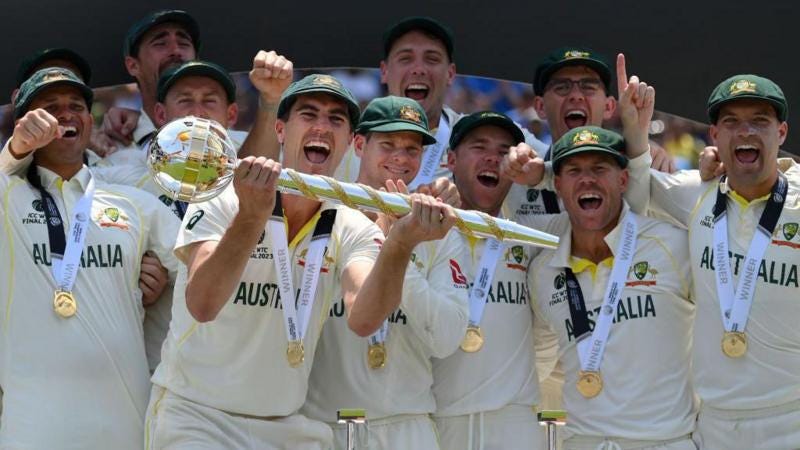
Pat Cummins led his side to victory in the WTC 2023 final against India.
Whilst Australia’s team as a whole has been of a generally high standard, the real secret behind their success is, of course, the bowling. In an era where the batting has been marked with retirements (David Warner, Usman Khawaja), inconsistency, and form decline (Marnus Labuschagne, Matthew Renshaw), the bowling has stayed remarkably strong, and many of Australia’s successes can be attributed to their bowlers.
The Fab Four
In cricket, the “fab four” usually refers to the spectacular batting quartet of Kane Williamson, Joe Root, Steve Smith, and Virat Kohli. However, Australia’s frontline bowling attack of Mitchell Starc, Pat Cummins, Josh Hazlewood, and Nathan Lyon is a fab four of its own.
Australia’s fab four has been the driving force behind their success.
Between the four, Australia has a combined 1,610 Test wickets—a simply incredible number. Their Test average between the four is just as impressive, coming in at 25.73. They also have immense experience, racking up a combined 394 Test caps between them. However, the other side of that coin is that the average age of Australia’s four best bowlers is 36. Add to that the fact that Cummins, Hazlewood, and Lyon all missed games through injury during their most recent Ashes series, and Australia’s indomitable bowling unit suddenly looks shakier. As good as they are right now, in ten months, or perhaps twelve, Australia’s greats are all going to retire (at least from Test cricket), and all at the same time.
The Parallel With the Past
In 2007, Australia was forced to undergo a similar transition, as Shane Warne, Glenn McGrath, Justin Langer, and Damien Martyn all retired following (or during) the 2007 Ashes series. This mass exodus ripped a hole in the Australian team, but the Baggy Greens were able to work around it, produce high-quality performances, and stay as one of Test cricket’s best teams. Why?
Because they had brilliant younger players who had been dominating and excelling in First-Class domestic cricket for years. Whilst McGrath had been grabbing headlines as one of Test cricket’s elite, Mitchell Johnson was tormenting Sheffield Shield batters on his road to 465 First-Class wickets. Similarly, Stuart Clark was able to slot into the Test side after impressing consistently for New South Wales. In addition, Australia was still in possession of the likes of Brett Lee and Ricky Ponting, able to steady the ship as younger players were integrated in. As a result, when the transition of power eventually came, Australia was more than ready and was able to maintain dominance despite losing four of their greatest cricketers.
This time around, however, Australia will enjoy no such luxury.
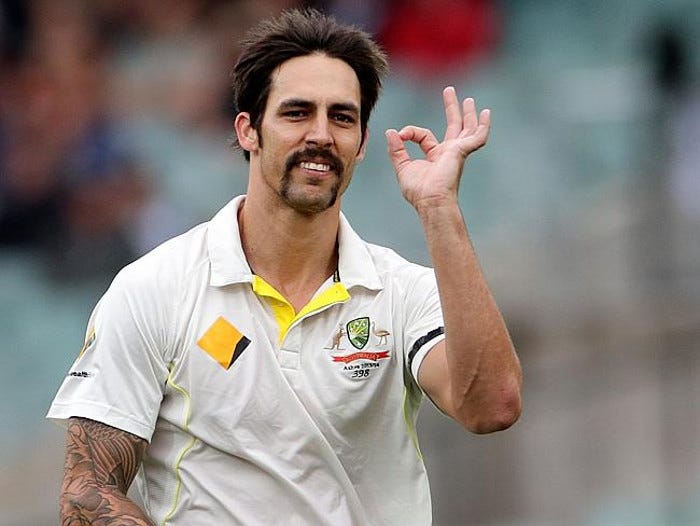
When the great Glenn McGrath retired in 2007, Australia already had a successor primed to replace him.
Australia’s best bowler outside of the “fab four” is Scott Boland—a terrific cricketer who, had he not had the misfortune to be playing during a golden generation, would no doubt have more than just 19 Test caps. However, Boland is 37, the second oldest of the five, and his Test career most likely will not extend beyond next season’s 2027 Ashes. Similarly, the man whom Australia turned to during the 25/26 Ashes when Cummins and Hazlewood were ruled out with injury, Michael Neser, is 36.
Age is catching up to Australia’s bowling attack, and unlike in 2007, their reserve players are not young enough to replace them. Furthermore, Australia is yet to really blood any young quicks in the longest format, which begs the question: once the fab four retire, who can Australia turn to to replace them?
Thank you for reading, and look out for Part II coming soon, talking about the potential successors for Australia’s Test team. :)
When you login first time using a Social Login button, we collect your account public profile information shared by Social Login provider, based on your privacy settings. We also get your email address to automatically create an account for you in our website. Once your account is created, you'll be logged-in to this account.
DisagreeAgree
I allow to create an account
When you login first time using a Social Login button, we collect your account public profile information shared by Social Login provider, based on your privacy settings. We also get your email address to automatically create an account for you in our website. Once your account is created, you'll be logged-in to this account.
DisagreeAgree
Please login to comment
3 Comments
Newest
OldestMost Voted
Wooliej
2 months ago
Based on past experience you’d expect it to be easy to bring in the next batch. I don’t understand why it’s all of a sudden too hard.







Based on past experience you’d expect it to be easy to bring in the next batch. I don’t understand why it’s all of a sudden too hard.
Jhye Richardson, Mitch Perry, O’Neil, Rocchicciolli/Kuhnemann ?
My first thought was Boland, but I didn’t realise he was 37. Yes, interesting times ahead.